Lorenzo Bellini
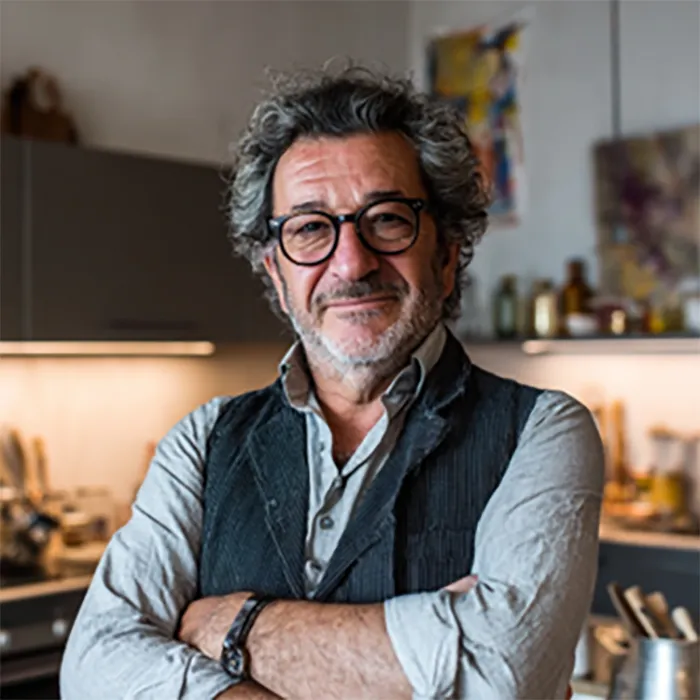
About Lorenzo Bellini
In the northern Italian city of Verona, where architecture is inseparable from daily life, a distinct design sensibility began to take shape in the early 1950s — one defined not by excess, but by restraint.
Born in 1953, Lorenzo Bellini is often associated with a design perspective rooted in material honesty and spatial clarity. His early environment was closely connected to traditional craftsmanship, where the process of making was as important as the final result. The presence of artisanal work — particularly in wood — contributed to a lasting sensitivity toward texture, proportion, and detail.
In his formative years, this foundation expanded through his architectural studies in Venice. Immersed in a city where structure, history, and light coexist in delicate balance, his approach evolved toward a more disciplined interpretation of space. Rather than pursuing expressive or decorative gestures, his work became increasingly focused on composition, function, and the emotional quality of interiors.
Material as Structure
To design spaces that look beautiful, feel comfortable, and work perfectly for your daily life.
A defining aspect often associated with his work is the role of wood as an architectural element.
In this context, wood is not treated as an applied surface, but as an integral part of the spatial composition — shaping atmosphere as much as structure. Grain, tone, and imperfection are preserved, allowing the material to retain its authenticity.
This approach is frequently paired with:
- Clean, continuous lines
- Subtle integration of stone and metal
- A careful balance between solidity and openness
The result is a language that feels both grounded and contemporary, where materials are allowed to speak without interruption.
From Utility to Anchor
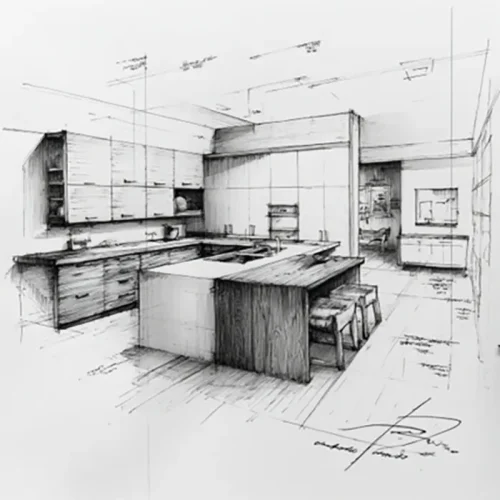
Design studies from the early 1990s reveal an interest in the evolving role of the kitchen within the home.
At a time when kitchens were still largely defined by enclosure and utility, these works reflect a gradual shift toward openness, interaction, and spatial continuity. Islands begin to emerge not only as functional elements, but as social anchors — suggesting a redefinition of how space is used and experienced.
Rather than presenting a sudden break from tradition, this transition appears as a measured progression — where familiar structures are reinterpreted through an architectural lens.
Today, the perspective associated with Lorenzo Bellini continues to resonate within a broader design dialogue centered on simplicity, material integrity, and proportion.
At Casa Verona Design, this influence is reflected in a commitment to interiors that prioritize clarity over complexity, and atmosphere over ornament. Each space is approached as a composition — where structure, material, and function come together in quiet balance.
What Makes Us Different
At Casa Verona Design, every project is approached with attention to detail and a clear vision. We focus on: